About this product
The TP-Link TL-SG3452 JetStream 48-Port Gigabit L2 Managed Switch is a high-capacity business networking solution designed to connect and manage multiple wired network devices efficiently. Featuring 48 x Gigabit Ethernet RJ45 ports, 4 x Gigabit SFP slots, a 104 Gbps switching capacity and advanced Layer 2 management capabilities, it provides reliable high-speed connectivity for enterprise networks, offices, schools and server environments. With VLAN support, Quality of Service (QoS), network security features and centralised management capabilities, this rack-mountable switch offers flexible network administration and traffic control. Buy the TP-Link TL-SG3452 online today for professional Gigabit network connectivity in South Africa.
Overview Summary
TP-Link TL-SG3452 JetStream 48-Port Gigabit L2 Managed Switch
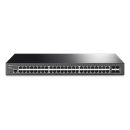
The TP-Link TL-SG3452 is designed for organisations requiring extensive wired network connectivity and centralised network administration. It provides 48 x 10/100/1000 Mbps RJ45 Ethernet ports for connecting computers, printers, servers, access points and other Ethernet-enabled devices. Four additional Gigabit SFP slots provide fibre connectivity options for network uplinks and connections between network switches.
With a 104 Gbps switching capacity and a packet forwarding rate of 77.4 Mpps, the TL-SG3452 supports high-volume network traffic across connected devices. Its managed networking capabilities include VLAN configuration, Quality of Service, Access Control Lists, IGMP Snooping and network monitoring. It also supports centralised management through compatible Omada controllers, making it suitable for structured business network deployments.
Performance tier: Enterprise / Business-class Managed Gigabit Networking
Uses: Business networks, enterprise LAN infrastructure, office networking, school networks, server connectivity, network distribution, VLAN segmentation, fibre uplinks, IP camera networks
Description
The TP-Link TL-SG3452 JetStream is a 48-port Gigabit Layer 2 managed switch developed for professional networking environments that require high port density, network traffic control and reliable wired connectivity. It provides a central connection point for multiple network devices, allowing businesses and organisations to build structured Ethernet networks with advanced management capabilities.
48 Gigabit Ethernet ports for extensive connectivity
The switch features 48 x 10/100/1000 Mbps RJ45 Ethernet ports, allowing multiple computers, network printers, servers, wireless access points and other Ethernet devices to connect to the same network infrastructure. Each Gigabit port supports high-speed wired connectivity for everyday business applications, file transfers and communication between network devices.
Four dedicated Gigabit SFP slots
In addition to its 48 Ethernet ports, the TL-SG3452 includes 4 x Gigabit SFP slots. These interfaces provide fibre uplink connectivity when used with compatible SFP transceiver modules. Fibre connections are useful for connecting switches across different areas of a building or extending network infrastructure between equipment rooms.
High switching capacity
With a 104 Gbps switching capacity and a packet forwarding rate of 77.4 Mpps, the TL-SG3452 is designed to handle substantial network traffic across its connected interfaces. Its 12 Mbit packet buffer and support for jumbo frames up to 9 KB help accommodate different network traffic requirements.
Advanced Layer 2 network management
The managed switching platform provides network administrators with control over network traffic, device access and network segmentation. VLAN configuration allows devices to be grouped into separate logical networks, while Access Control Lists help administrators apply network access policies. Quality of Service provides traffic prioritisation for applications that require consistent network performance.
Network monitoring and administration
The TL-SG3452 supports management through a web-based graphical interface, command-line interface, SNMP and RMON. Compatible Omada management solutions provide centralised administration for supported network devices, helping simplify network configuration and monitoring.
Rack-mountable business design
Designed for professional network installations, the switch features a durable metal enclosure and rack-mountable construction. Its fanless design supports silent operation, making it suitable for offices and other environments where equipment noise should be minimised.
The TP-Link TL-SG3452 is a practical networking solution for businesses, educational facilities and organisations that need a high-density Gigabit Ethernet switch with fibre uplink options and advanced network management capabilities.
Features
The TP-Link TL-SG3452 combines high-density Gigabit connectivity with managed networking features for professional business network installations.
- 48 Gigabit Ethernet ports: Provides 48 x 10/100/1000 Mbps RJ45 connections for computers, servers, printers, access points and other wired network devices.
- 4 Gigabit SFP slots: Supports compatible Gigabit SFP transceiver modules for fibre uplink connections and network expansion.
- 104 Gbps switching capacity: Provides substantial switching bandwidth for handling traffic across connected network devices.
- 77.4 Mpps forwarding rate: Supports high-speed packet forwarding for business networking applications.
- Layer 2 managed switching: Provides configurable network management features for controlling and organising connected devices.
- VLAN support: Allows administrators to divide a physical network into separate logical network segments.
- Quality of Service (QoS): Provides traffic prioritisation to help manage bandwidth for important network applications.
- Access Control Lists (ACL): Helps administrators manage network access and implement traffic filtering policies.
- IGMP Snooping: Helps optimise multicast traffic distribution across the network.
- Static routing: Supports Layer 3 routing capabilities for internal network traffic management.
- Network security: Supports security and access management features to help protect network infrastructure.
- Centralised management: Supports compatible Omada controllers for unified management of supported network devices.
- Web-based management: Provides a graphical interface for network configuration and administration.
- SNMP and RMON support: Provides network monitoring and management capabilities for administrators.
- Fanless operation: Uses a fanless design for silent operation.
- Rack-mountable construction: Designed for installation in compatible network equipment racks.
Software Defined Networking (SDN) with Cloud Access
Omada's Software Defined Networking (SDN) platform integrates network devices, including access points, switches and gateways, providing 100% centralized cloud management. Omada creates a highly scalable network-all controlled from a single interface. Seamless wireless and wired connections are provided, ideal for use in hospitality, education, retail, offices, and more.
Advanced L3 Features**
An abundance of L2+ and L3 features are supported to help build a highly scalable and robust network, providing a reliable and efficient solution for enterprises, campuses and ISPs.
Secure Networking Security features include IP-MAC-Port-VID Binding, Port Security, Storm Control and DHCP Snooping to defend against a range of network threats. An integrated list of common DoS attacks is available, making it easier than ever to prevent them. In addition, the Access Control Lists (ACL, L2 to L4) feature restricts access to sensitive network resources by denying packets based on source and destination MAC address, IP address, TCP/UDP ports or VLAN ID. Users' network access can be controlled via 802.1X authentication, which works with a RADIUS/Tacacs+ server to grant access only when valid user credentials are provided.
Enterprise Level Features
A complete lineup of L2+ features are supported, including 802.1Q VLAN, Port Mirroring, STP/RSTP/MSTP, Link Aggregation Control Protocol, and 802.3x Flow Control. Advanced IGMP Snooping ensures the switch intelligently forwards multicast streams to only the appropriate subscribers, cutting out unnecessary traffic, while IGMP throttling & filtering restrict each subscriber on a port level to prevent unauthorized multicast access. Static Routing is a simple way of segmenting the network and internally routs traffic through the switch for improved efficiency.
Advanced QoS Voice and video traffic can be prioritized based on IP address, MAC address, TCP port number, UDP port number, and more. With QoS (Quality of Service), voice and video services remain smooth, even when bandwidth is in short supply.
ISP Features**
QinQ, L2PT, PPPoE ID Insertion, and IGMP authentication features are provided, developed with service providers in mind. Device Link Detection Protocol (DLDP) offers easy monitoring and troubleshooting of Ethernet links.
IPv6 Support IPv6 functions such as Dual IPv4/IPv6 Stack, MLD Snooping, IPv6 ACL, DHCPv6 Snooping, IPv6 Interface, Path Maximum Transmission Unit (PMTU) Discovery and IPv6 Neighbor Discover guarantee your network is ready for the Next Generation Network (NGN) without upgrading your hardware.
What's in the Box
- TP-Link TL-SG3452 JetStream 48-Port Gigabit Managed Switch
- Power Cord
- Rackmount Kit
- Rubber Feet
- Quick Installation Guide
Specifications
| ©2026 Respective owners and brand holders. This table has been carefully researched and generated by ComXpert International CC (//www.comx-computers.co.za), however, errors and omissions may occur. Only references to South Africa apply. All products are sourced in South Africa from the official suppliers and the warranty is that of the local supplier. E&OE. This table and our site's content may be used on condition that this notice and link remains intact and unaltered. |
Specifications |
| Product Code | TP SG3452 |
| HARDWARE FEATURES |
| Interface | 48x 10/100/1000 Mbps RJ45 Ports |
| 4x Gigabit SFP Slots |
| 1x RJ45 Console Port |
| 1x Micro-USB Console Port |
| Fan Quantity | Fanless |
| Power Supply | 100-240 V AC~50/60 Hz |
| Dimensions ( W x D x H ) | 17.3x8.7x1.7 in (440x220x44 mm) |
| Mounting | Rack Mountable |
| Max Power Consumption | 32.8 W (220 V/ 50 Hz) |
| Max Heat Dissipation | 111.91 BTU/h (220 V / 50 Hz) |
| PERFORMANCE |
| Switching Capacity | 104 Gbps |
| Packet Forwarding Rate | 77.4 Mpps |
| MAC Address Table | 16 K |
| Packet Buffer Memory | 12 Mbit |
| Jumbo Frame | 9 KB |
| SOFTWARE FEATURES |
| Quality of Service | 8 priority queues |
| 802.1p CoS/DSCP priority |
| Queue scheduling |
| - SP (Strict Priority) |
| - WRR (Weighted Round Robin) |
| - SP+WRR |
| Bandwidth Control |
| - Port/Flow based Rating Limiting |
| Smoother Performance |
| Action for Flows |
| - Mirror (to supported interface) |
| - Redirect (to supported interface) |
| - Rate Limit |
| - QoS Remark |
| L3 Features | 16 IPv4/IPv6 Interfaces |
| Static Routing |
| - 48 static routes |
| Static ARP |
| 316 ARP Entries |
| Proxy ARP |
| Gratuitous ARP |
| DHCP Server |
| DHCP Relay |
| DHCP L2 Relay |
| L2 and L2+ Features | Link Aggregation |
| - Static link aggregation |
| - 802.3ad LACP |
| - Up to 8 aggregation groups and up to 8 ports per group |
| Spanning Tree Protocol |
| - 802.1d STP |
| - 802.1w RSTP |
| - 802.1s MSTP |
| - STP Security: TC Protect, BPDU Filter, BPDU Protect, Root Protect, Loop Protect |
| Loopback Detection |
| - Port-based |
| - VLAN based |
| Flow Control |
| - 802.3x Flow Control |
| - HOL Blocking Prevention |
| Mirroring |
| - Port Mirroring |
| - CPU Mirroring |
| - One-to-One |
| - Many-to-One |
| - Tx/Rx/Both |
| L2 Multicast | Supports 511 (IPv4, IPv6) IGMP groups |
| IGMP Snooping |
| - IGMP v1/v2/v3 Snooping |
| - Fast Leave |
| - IGMP Snooping Querier |
| - IGMP Authentication |
| IGMP Authentication |
| MVR |
| MLD Snooping |
| - MLD v1/v2 Snooping |
| - Fast Leave |
| - MLD Snooping Querier |
| - Static Group Config |
| - Limited IP Multicast |
| Multicast Filtering: 256 profiles and 16 entries per profile |
| Advanced Features | Support Omada Hardware Controller (OC200/OC300), Software Controller |
| Automatic Device Discovery |
| Batch Configuration |
| Batch Firmware Upgrading |
| Intelligent Network Monitoring |
| Abnormal Event Warnings |
| Unified Configuration |
| Reboot Schedule |
| VLAN | VLAN Group |
| - Max 4K VLAN Groups |
| 802.1q Tagged VLAN |
| MAC VLAN: 12 Entries |
| Protocol VLAN: Protocol Template 16, Protocol VLAN 16 |
| GVRP |
| VLAN VPN (QinQ) |
| - Port-Based QinQ |
| - Selective QinQ |
| Voice VLAN |
| Access Control List | Time-based ACL |
| MAC ACL |
| - Source MAC |
| - Destination MAC |
| - VLAN ID |
| - User Priority |
| - Ether Type |
| IP ACL |
| - Source IP |
| - Destination IP |
| - Fragment |
| - IP Protocol |
| - TCP Flag |
| - TCP/UDP Port |
| - DSCP/IP TOS |
| - User Priority |
| Combined ACL |
| Packet Content ACL |
| IPv6 ACL |
| Policy |
| - Mirroring |
| - Redirect |
| - Rate Limit |
| - QoS Remark |
| ACL apply to Port/VLAN |
| Security | IP-MAC-Port Binding |
| - DHCP Snooping |
| - ARP Inspection |
| - IPv4 Source Guard |
| IPv6-MAC-Port Binding |
| - DHCPv6 Snooping |
| - ND Detection |
| - IPv6 Source Guard |
| DoS Defend |
| Static/Dynamic Port Security |
| - Up to 64 MAC addresses per port |
| Broadcast/Multicast/Unicast Storm Control |
| - kbps/ratio/pps control mode |
| IP/Port/MAC based access control |
| 802.1X |
| - Port based authentication |
| - Mac based authentication |
| - VLAN Assignment |
| - MAB |
| - Guest VLAN |
| - Support Radius authentication and |
| accountability |
| AAA (including TACACS+) |
| Port Isolation |
| Secure web management through HTTPS with SSLv3/TLS 1.2 |
| Secure Command Line Interface (CLI) management with SSHv1/SSHv2 |
| IPv6 | IPv6 Dual IPv4/IPv6 |
| Multicast Listener Discovery (MLD) Snooping |
| IPv6 ACL |
| IPv6 Interface |
| Static IPv6 Routing |
| IPv6 neighbor discovery (ND) |
| Path maximum transmission unit (MTU) discovery |
| Internet Control Message Protocol (ICMP) version 6 |
| TCPv6/UDPv6 |
| IPv6 applications |
| - DHCPv6 Client |
| - Ping6 |
| - Tracert6 |
| - Telnet (v6) |
| - IPv6 SNMP |
| - IPv6 SSH |
| - IPv6 SSL |
| - Http/Https |
| - IPv6 TFTP |
| Management | Web-based GUI |
| Command Line Interface (CLI) through console port, telnet |
| SNMPv1/v2c/v3 |
| - Trap/Inform |
| - RMON (1, 2, 3, 9 groups) |
| SDM Template |
| DHCP/BOOTP Client |
| 802.1ab LLDP/LLDP-MED |
| DHCP AutoInstall |
| Dual Image, Dual Configuration |
| CPU Monitoring |
| Cable Diagnostics |
| EEE |
| Password Recovery |
| SNTP |
| System Log |
| MIBs | MIB II (RFC1213) |
| Bridge MIB (RFC1493) |
| P/Q-Bridge MIB (RFC2674) |
| Radius Accounting Client MIB (RFC2620) |
| Radius Authentication Client MIB (RFC2618) |
| Remote Ping, Traceroute MIB (RFC2925) |
| Support TP-Link private MIBs |
| RMON MIB(RFC1757, rmon 1,2,3,9) |
| MANAGEMENT |
| Omada App | Yes. Requiring the use of OC300, OC200, Omada Cloud-Based Controller, or Omada Software Controller. |
| Centralized Management | Omada Cloud-Based Controller |
| Omada Hardware Controller (OC300) |
| Omada Hardware Controller (OC200) |
| Omada Software Controller |
| Cloud Access | Yes. Requiring the use of OC300, OC200, Omada Cloud-Based Controller, or Omada Software Controller. |
| Zero-Touch Provisioning | Yes. Requiring the use of Omada Cloud-Based Controller. |
| Management Features | Web-based GUI |
| Command Line Interface (CLI) through console port, telnet |
| SNMPv1/v2c/v3 |
| - Trap/Inform |
| - RMON (1, 2, 3, 9 groups) |
| SDM Template |
| DHCP/BOOTP Client |
| 802.1ab LLDP/LLDP-MED |
| DHCP AutoInstall |
| Dual Image, Dual Configuration |
| CPU Monitoring |
| Cable Diagnostics |
| EEE |
| Password Recovery |
| SNTP |
| System Log |
| OTHERS |
| Certification | CE, FCC, RoHS |
| Package Contents | TL-SG3452 Switch |
| Power Cord |
| Quick Installation Guide |
| Rackmount Kit |
| Rubber Feet |
| System Requirements | Microsoft Windows 98SE, NT, 2000, XP, Vista or Windows 7/8/10/11, MAC OS, NetWare, UNIX or Linux. |
| Environment | Operating Temperature: 0-40 degreesC (32-104 degreesF); |
| Storage Temperature: -40-70 degreesC (-40-158 degreesF) |
| Operating Humidity: 10-90% RH non-condensing |
| Storage Humidity: 5-90% RH non-condensing |
FAQ
What is the TP-Link TL-SG3452 used for?
The TP-Link TL-SG3452 is used to connect and manage multiple wired network devices within business networks, offices, schools, server rooms and enterprise network installations.
How many Ethernet ports does the TL-SG3452 have?
The TL-SG3452 has 48 Gigabit RJ45 Ethernet ports supporting 10/100/1000 Mbps connections.
Does the TP-Link TL-SG3452 support fibre connectivity?
Yes. It features 4 Gigabit SFP slots for compatible SFP transceiver modules, allowing fibre uplink connections to compatible networking equipment.
Is the TL-SG3452 a managed switch?
Yes. It is a Layer 2 managed switch with configurable VLAN, QoS, network access control, monitoring and traffic management features.
Does the TL-SG3452 support VLAN?
Yes. VLAN support allows network administrators to separate connected devices into logical network segments to improve network organisation, security and traffic management.
What is the switching capacity of the TL-SG3452?
The TP-Link TL-SG3452 has a switching capacity of 104 Gbps and a packet forwarding rate of 77.4 Mpps.
Can the TL-SG3452 be managed remotely?
Yes. It supports compatible Omada centralised management solutions, allowing network administrators to configure and monitor supported network equipment through a unified management platform.
Does the TL-SG3452 support Power over Ethernet (PoE)?
The TL-SG3452 is a standard Gigabit managed switch and does not provide PoE power output. Devices requiring PoE must use a separate PoE switch or suitable PoE power injector.
Can the TL-SG3452 be installed in a server rack?
Yes. The switch is rack-mountable and includes a rackmount kit for installation in compatible network equipment racks.
Does the TL-SG3452 have cooling fans?
No. The TL-SG3452 uses a fanless design, supporting silent operation in suitable office and network equipment environments.
What devices can connect to the TL-SG3452?
Compatible Ethernet devices include desktop computers, laptops with Ethernet connectivity, network printers, servers, wireless access points, IP cameras and other network-enabled equipment.
What is the difference between the RJ45 ports and SFP slots?
The 48 RJ45 ports provide Gigabit Ethernet connections using standard network cabling, while the 4 SFP slots accommodate compatible optical or other supported SFP transceiver modules for network uplinks.
Is the TP-Link TL-SG3452 suitable for business networks?
Yes. Its 48 Gigabit Ethernet ports, fibre uplink options, managed switching capabilities and centralised administration support make it suitable for business and enterprise network infrastructure.





 Up
 Down


 Mobile store